
Carbonization of Ageratum conyzoides Leaves and Characterization for Supercapacitor Active Electrode Performance
DOI:
https://doi.org/10.35895/jpsi.2.2.134-144.2026Keywords:
Ageratum conyzoides, activated carbon, supercapacitor, carbonization, cyclic voltammetryAbstract
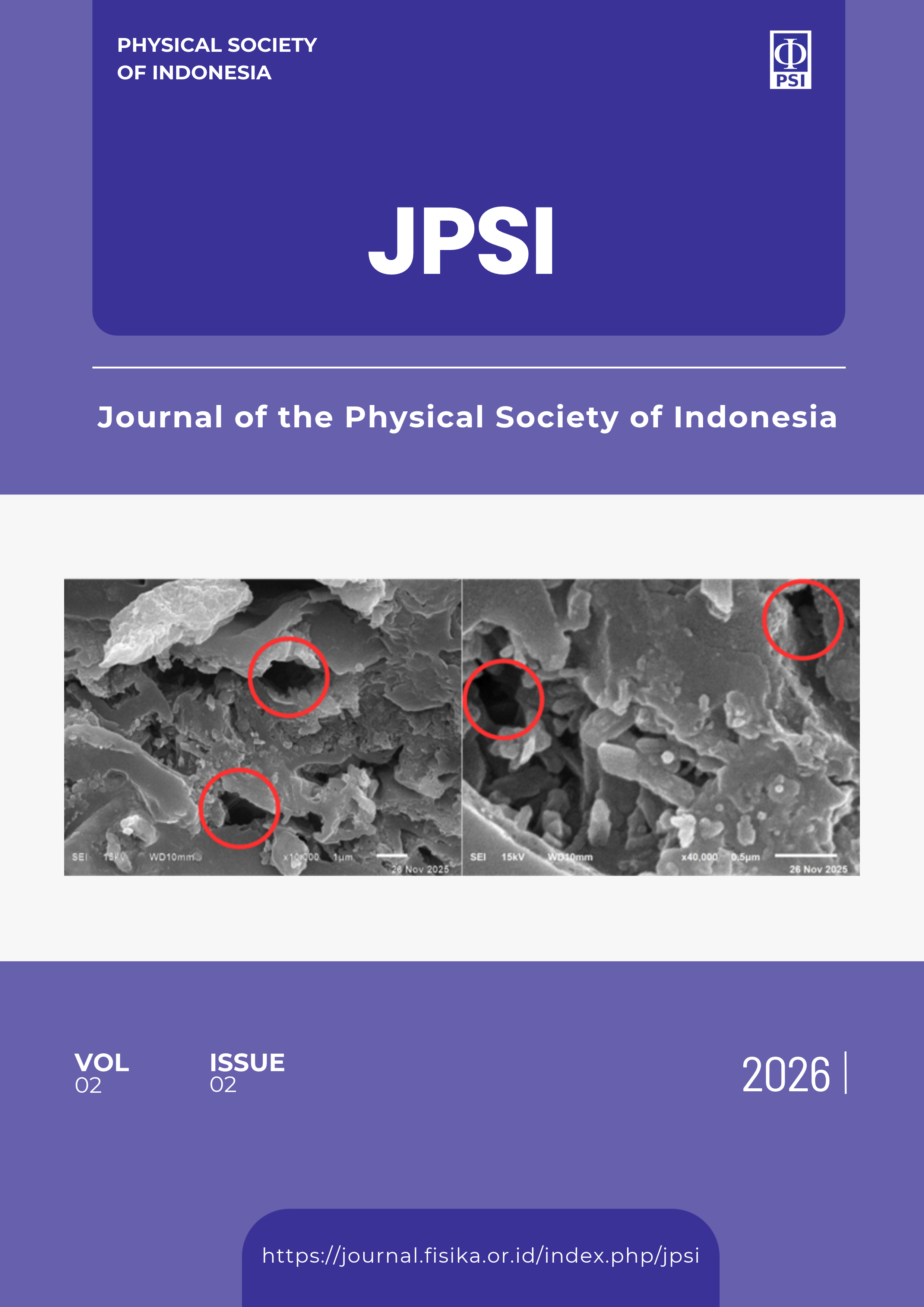
This study evaluated the viability of the invasive weed Ageratum conyzoides as a carbon precursor for supercapacitor electrodes. The research aimed to determine the optimal carbonization temperature for maximizing the specific capacitance. The biomass underwent chemical activation using 0.3 M KOH. Subsequently, the samples were carbonized in an N2 atmosphere at varying temperatures (600, 700, and 800°C) and physically activated with CO2 at 800°C. Structural and morphological characterizations using thermogravimetric analysis (TG-DTG), X-ray diffraction (XRD), Fourier transform infrared (FTIR) spectroscopy, and scanning electron microscopy (SEM) confirmed the successful decomposition of organic components into a highly porous amorphous carbon network. An increase in the carbonization temperature directly correlated with a reduction in material density, indicating enhanced pore formation. Electrochemical measurements via cyclic voltammetry in a 1 M H2SO4 electrolyte revealed that the electrode carbonized at 800°C delivered a maximum specific capacitance of 75.97 F/g, compared to 58.21 F/g and 40.09 F/g for the 600°C and 700°C variants, respectively. These findings established both the ecological and technical potential of converting an invasive weed into functional energy storage materials.
References
Armynah, B., Erwinda, E., Agustino, A., Taer, E., Mahmud, S., & Tahir, D. (2023). Biowaste-derived oxygen-self-doped three-dimensional interconnected porous carbon for electrochemical supercapacitor applications. Energy Sources, Part A: Recovery, Utilization, and Environmental Effects, 45(2), 6331–6342. https://doi.org/10.1080/15567036.2023.2215198
Armynah, B., Nairanti, D., Agustino, A., Taer, E., & Tahir, D. (2024). Discarded Persea americana leaf-derived natural O, Mg, and Ca self-doped activated carbon and its applications as electrode materials for high-performance symmetric supercapacitors. Diamond and Related Materials, 143, 110879. https://doi.org/10.1016/j.diamond.2024.110879
Armynah, B., Sari, S. I., Agustino, A., Taer, E., & Tahir, D. (2025). Tetra-heteroatom natural-doped activated carbon derived from cocoa leaf waste for advanced symmetric supercapacitors. Journal of Power Sources, 642, 236947. https://doi.org/10.1016/j.jpowsour.2025.236947
Armynah, B., Ayad Muayyad, A. M., Agustino, A., Taer, E., Apriwandi, A., Ismardi, A., Fathona, I. W., Rosi, M., Haryanti, N. H., Suryajaya, S., Isnasyauqiah, I., Usman, I., Julnaidi, J., Taslim, R., & Tahir, D. (2026). Heteroatom self-doped activated carbon from Moringa seed shells via KOH/CO₂ double activation for high-performance supercapacitors. Advanced Powder Technology, 37(11), 105427. https://doi.org/10.1016/j.apt.2026.105427
Batish, D. R., Singh, H. P., Kohli, R. K., & Kaur, S. (2006). Ageratum conyzoides: A noxious weed. In Invasive Plants: Ecological Threats and Management Options. Wiley-VCH.
Bejjanki, D., Banothu, P., Kumar, V. B., & Kumar, P. S. (2023). Biomass-derived N-doped activated carbon from Eucalyptus leaves as an efficient supercapacitor electrode material. C, 9(1), 24. https://doi.org/10.3390/c9010024
El-Hofy, M. S., Ebrahim, S., Ali, A. E., Elasala, G. S., & Sakr, A.-H. (2025). Supercapacitor electrode fabricated by activated carbon obtained from peels of sunflower seeds (Helianthus annuus L.). Chemistry Research Journal, 10(2), 35–46.
Feng, S., & Lazkano, I. (2025). Energy storage and clean energy transitions. Energy Policy, 198, 114447. https://doi.org/10.1016/j.enpol.2024.114447
Gielen, D., Boshell, F., Saygin, D., Bazilian, M. D., Wagner, N., & Gorini, R. (2019). The role of renewable energy in the global energy transformation. Energy Strategy Reviews, 24, 38–50. https://doi.org/10.1016/j.esr.2019.01.006
Gopi, C. V. V. M., & Ramesh, R. (2024). Review of battery-supercapacitor hybrid energy storage systems for electric vehicles. Results in Engineering, 24, 103598. https://doi.org/10.1016/j.rineng.2024.103598
Jaliaz, A., & Awitdrus, A. (2025). Making supercapacitor carbon electrodes from lemongrass leaf biomass with variations in physical activation temperature. Komunikasi Fisika Indonesia, 22(1), 49–52. https://doi.org/10.31258/jkfi.22.1.49-52
Kaur, S., Batish, D. R., Kohli, R. K., & Singh, H. P. (2012). Ageratum conyzoides: An alien invasive weed in India. In J. R. Bhatt, J. S. Singh, S. P. Singh, R. S. Tripathi, & R. K. Kohli (Eds.), Invasive alien plants: An ecological appraisal for the Indian subcontinent (pp. 57–76). CABI.
Komal, Kumar, A., Kumar, Y., & Shukla, V. K. (2023). Parthenium hysterophorus derived activated carbon for EDLC device application. Journal of Materials Science: Materials in Electronics, 34(28), 1880. https://doi.org/10.1007/s10854-023-11309-6
Shrestha, D. (2025). High-performance supercapacitor electrodes from optimized single-step carbonized Michelia champaca biomass. Journal of Environmental & Earth Sciences, 7(6), 1–22. https://doi.org/10.30564/jees.v7i6.8444
Taer, E., Apriwandi, A., Andani, D. R., & Taslim, R. (2021). Solid coin-like design activated carbon nanospheres derived from shallot peel precursor for boosting supercapacitor performance. Journal of Materials Research and Technology, 15, 1732–1741. https://doi.org/10.1016/j.jmrt.2021.09.025
Zhang, W., Qiu, X., Wang, C., Zhong, L., Fu, F., Zhu, J., Zhang, Z., Qin, Y., Yang, D., & Xu, C. C. (2022). Lignin derived carbon materials: Current status and future trends. Carbon Research, 1(1), 14. https://doi.org/10.1007/s44246-022-00009-1
Downloads
Published
Issue
Section
License
Copyright (c) 2026 Muhammad Ikram Handaru Putra, Bidayatul Armynah, Arifin Arifin, Dahlang Tahir (Author)

This work is licensed under a Creative Commons Attribution-NonCommercial 4.0 International License.